
What happened?
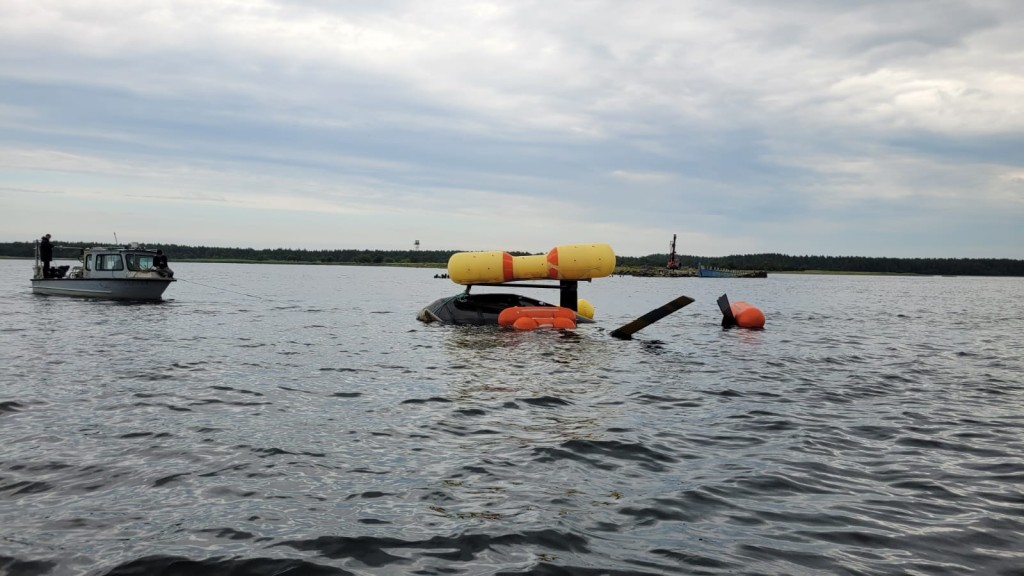
On 6th of July 2025 at 11:06, a private owned Airbus Helicopters EC130 helicopter registered as ES-AME took off from a grass field on Vilsandi island (Estonia) to fly to Suurupi helicopter operating site (EESI) on mainland Estonia with the pilot in command (hereafter referred as “captain”), second pilot and 5 passengers on board. The weather was cloudy, overcast at 230 ft (70 m) and the wind blowing from southwest at 232°. Following a successful take-off in headwind, the aircraft turned tailwind, gained altitude and started flying towards Suurupi. When the helicopter reached the coastline of the island (Vilsandi) it slowly started to lose altitude and at 11:08:20 tilted steeply towards the sea, quickly lost altitude and crashed into the gulf of Kihelkonna. At 11:08:34 the helicopter touched the water surface with the right side towards the movement direction. During the impact the rotor blades hit the water surface, the engine stopped and the emergency float system (EFS) was triggered while the aircraft was floating on the right side. As the emergency floats were inflated the helicopter tipped over and the pilot and the passengers climbed out of the wreckage and onto the underside of the floating helicopter. The pilot and the passengers used their mobile phones to call for help at 11:17 and approximately 11:35 were rescued by local SAR unit and were taken to the port of Vikati on the island of Vilsandi. During the accident the pilots and the passengers suffered minor trauma. The helicopter’s main frame, tail boom, main and rear rotor, fuselage skin and the aircraft main structure suffered severe damage resulting in aircraft hull loss.
Animated reconstruction of the accident
Why it happened?
The safety investigation found no evidence of any technical malfunction in the helicopter's flight control system, engine, or other technical systems that could have caused or contributed to the accident.
"The accident resulted from commencing the flight in weather conditions that were marginal or below the minimum required for visual flight, and from continuing the flight under visual flight rules into further deteriorating visibility. As a result, spatial orientation was lost, leading to an inadvertent descent and collision with the sea," concluded Karl-Eerik Unt, Aviation Accident Senior Investigator at the Estonian Safety Investigation Bureau.
The safety investigation also identified a shortcoming in the external detection of the accident. Although a flight plan had been filed for the accident helicopter and the helicopter was transmitting ADS-B data, which were received and recorded by the air navigation service provider’s WAM infrastructure, the pilot had not activated the flight plan before departure, and the ADS-B data were not operationally available at the air traffic services (ATS/FIS) controller workstations. As a result, air traffic controllers had no real-time awareness of the flight or the occurrence of the accident through their operational systems. Consequently, they had no opportunity to initiate the dispatch of emergency assistance to the accident site.
What can be improved?
As a result of the safety investigation, the Estonian Safety Investigation Bureau issued the following safety recommendations to prevent similar occurrences in the future or to mitigate their consequences.
Recommendation to the operator and relevant helicopter operators conducting similar VFR passenger flights:
- Introduce recurrent training and standard operating guidance for inadvertent IMC avoidance, escape manoeuvres, crew coordination and decision points for turning back, delaying departure or diverting when low cloud or reduced visibility are encountered.
Recommendations to the Estonian Transport Administration:
- Promote the use of official weather data sources amongst private aircraft operators.
- Together with EANS develop tools, based on EANS WAM ADS-B data, to identify flights in uncontrolled airspace that are executed under 150 m (500 ft).
The accident reveals that private helicopter operations in Estonia are executed under the required flight height minima. The availability of EANS WAM ADS-B data to the Estonian Transport Administration can assist in flagging the flights that are not conducted according to SERA rules, thereby increasing the quality of regulatory oversight and overall safety of aviation.
Recommendations to Estonian Air Navigation Services (EANS):
- Assess and develop the capability to make ADS-B surveillance data received by the EANS WAM infrastructure available on the operational ATS/FIS working positions, particularly for low-level flights in uncontrolled airspace where conventional surveillance coverage is limited.
The availability of such information could improve the situational awareness of air traffic controllers and flight information service officers, support earlier detection of abnormal situations, and contribute to more timely alerting and SAR response in the event of an accident or emergency involving low-level aircraft operations.
- Assess whether technical means can be implemented to flag abrupt ADS-B track termination, abnormal last-point behaviour or stationary final positions, so that survivable accidents are identified earlier and rescue assets can be tasked sooner.
The Estonian Safety Investigation Bureau conducted the safety investigation of the accident in accordance with the regulations of the International Civil Aviation Organisation's (ICAO) and European Union regulations.

